

Healthcare data privacy isn't just a compliance checkbox. It's the difference between a patient trusting you with their most sensitive information and that information ending up in the wrong hands. Every time a clinician sends a message containing patient details over an unsecured channel, they create a record that can sit on servers, in email archives, or on personal devices indefinitely. Self-destructing messages close that window by making the data disappear after it's been read.
Content Table
- Why Standard Messaging Fails Clinicians
- What HIPAA Actually Requires for Messaging
- The Real Risk: Data at Rest, Not Just Data in Transit
- How Self-Destructing Messages Work in Clinical Settings
- Burn-After-Reading Options Clinicians Should Know
- Practical Use Cases for Ephemeral Clinical Communication
- What to Look for in a Secure Clinical Communication Tool
Why Standard Messaging Fails Clinicians
Most clinicians already know they shouldn't text patient information over standard SMS. But the problem goes deeper than the obvious channels. Consider what actually happens in a typical clinical day:
- A nurse texts a physician a patient's lab result over a personal messaging app.
- An administrator emails a discharge summary to a specialist using a generic email account.
- A care coordinator shares login credentials for a shared patient portal via a group chat.
Each of these actions creates a persistent record. The message sits on the sender's device, the recipient's device, and on the servers of whatever platform carried it. If either device is lost, stolen, or hacked, that patient data is exposed. If the platform is subpoenaed or breached, the data is exposed again. Standard messaging was never designed with medical record privacy in mind.
What HIPAA Actually Requires for Messaging
The HIPAA Security Rule doesn't ban texting outright, but it does require covered entities to implement safeguards that protect electronic protected health information (ePHI) in transit and at rest. For messaging specifically, that means:
- Encryption in transit: Messages carrying ePHI must be encrypted while being transmitted.
- Access controls: Only authorized individuals should be able to read the message.
- Audit controls: There should be a way to track who accessed what and when.
- Automatic logoff: Sessions or message access should time out after a period of inactivity.
- Minimum necessary standard: Only the information needed for the clinical purpose should be shared.
The "minimum necessary" standard is where self-destructing messages become especially relevant. If a message containing patient data deletes itself after it's been read, the exposure window shrinks dramatically. The data existed long enough to serve its purpose and then it was gone.
The minimum necessary requirement is one of the most frequently misunderstood parts of HIPAA. Sharing a full patient chart when only a medication name was needed is a violation, even if the channel was technically secure.
The Real Risk: Data at Rest, Not Just Data in Transit
Most security discussions focus on data in transit, meaning the moment a message travels from one device to another. But in healthcare, the bigger long-term risk is often data at rest. That's the message that was delivered successfully but is still sitting in an inbox six months later.
The HHS Breach Notification Rule requires covered entities to notify affected individuals, the Secretary of HHS, and in some cases the media when unsecured ePHI is breached. A single compromised device containing months of clinical messages could trigger notifications affecting hundreds of patients.
Self-destructing messages solve the data-at-rest problem by design. Once a message is read and deleted, there's nothing left to breach.
How Self-Destructing Messages Work in Clinical Settings
The core mechanism is straightforward. A clinician creates a note or message containing patient information. That message is encrypted and stored on a server. A unique link is generated. The recipient opens the link, the content decrypts on their screen, and the server immediately deletes the original. No copy remains anywhere except what the recipient is currently viewing, and even that disappears when they close the tab or after a short countdown.
This approach handles several HIPAA compliant texting concerns at once:
- The message is encrypted both in transit and at rest (until deletion).
- Access is controlled by possession of the unique link.
- The data retention period is minimal by design.
- There's no persistent copy on the sender's device, the recipient's device, or the server.
Burn-After-Reading Options Clinicians Should Know
Not all self-destruct configurations are equal. Depending on the sensitivity of the patient data sharing scenario, you'll want different settings. Here's how the main options work and when to use each:
| Option | What It Does | Best For |
|---|---|---|
| Auto-delete timer (lifetime) | Deletes the note after a set period (1 hour to 30 days) if nobody opens it. | Time-sensitive referrals or handoff notes that expire if not acted on. |
| Burn after reading | Permanently deletes the note from the server the moment it's fetched for decryption. Enabled by default. | Any ePHI that should only be read once, like a one-time access code or a single lab result. |
| Burn while viewing (30-second window) | After the first open, the page shows a countdown from 30 seconds. At zero, the page refreshes and clears the content from the browser. The server already deleted the note at open time. | Highly sensitive data where you want to ensure the recipient reads it promptly and can't leave it open indefinitely. |
| Instant reveal (Direct view) | Adds a parameter to the share URL so the content decrypts automatically on open, without requiring the recipient to click a button. | Situations where the recipient needs frictionless access, such as urgent clinical handoffs. |
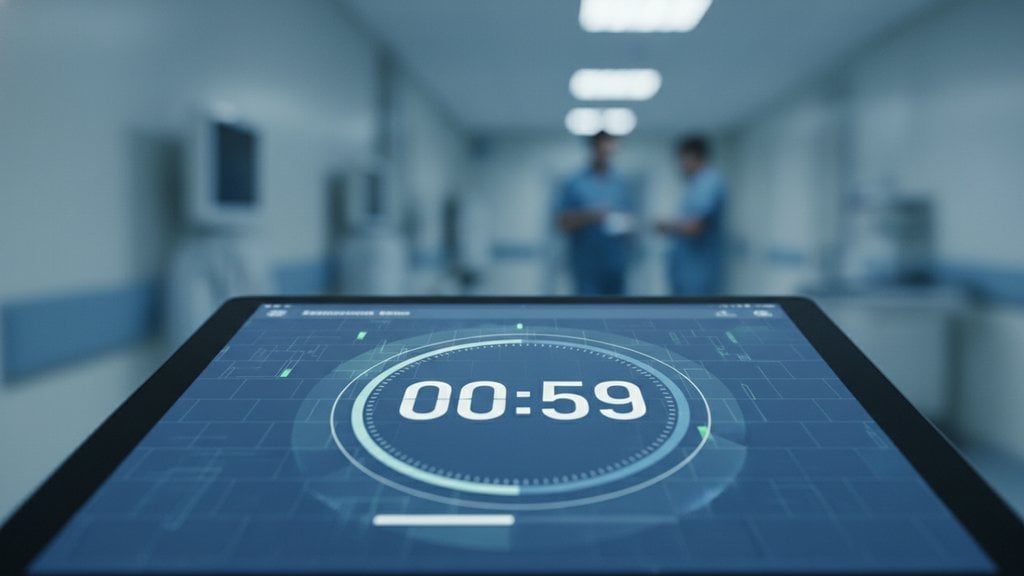
The 30-second burn window is worth understanding in detail. When a recipient opens a note with this setting enabled, a visible countdown timer appears on screen: "This note will clear in Xs." The countdown ticks from 30 to 0. At 0, the page automatically reloads and all decrypted content is cleared from the browser. The server has already deleted the note at the moment of first open, so there's nothing to retrieve even if someone tries to reload manually.
Practical Use Cases for Ephemeral Clinical Communication
Self-destructing messages aren't a replacement for your EHR or your primary clinical documentation system. They fill a specific gap: the informal, urgent, or one-time communication that doesn't belong in a formal record but still contains sensitive information.
- Sharing temporary credentials: A locum physician needs one-time access to a portal. Send the username and password as a burn-after-reading note. Once they've logged in, the credentials are gone.
- Urgent lab results between providers: A pathologist needs to flag a critical result to a surgeon before the formal report is ready. A self-destructing note carries the finding without creating a persistent uncontrolled copy.
- Care coordination between facilities: Transferring a patient between a hospital and a skilled nursing facility often involves informal communication that falls outside the EHR workflow. Ephemeral notes keep that communication secure.
- Sharing sensitive diagnoses with referring physicians: A psychiatrist communicating a diagnosis to a primary care provider for care coordination purposes can use a one-read note that disappears after the referring physician has seen it.
- On-call handoffs: Quick notes about patient status at shift change that contain enough detail to be useful but shouldn't persist on personal devices.
What to Look for in a Secure Clinical Communication Tool
When evaluating any tool for HIPAA compliant texting or secure clinical communication, the questions to ask are:
- Is the content encrypted end-to-end, or only in transit?
- Does the server delete the message after it's been read, or does it retain a copy?
- Can you set a maximum lifetime for unread messages?
- Does the tool require the recipient to create an account, or can they access the message via a link?
- Is there a visible confirmation that the message was deleted after reading?
- Does the tool have a Business Associate Agreement (BAA) available for covered entities?
The BAA question is critical. Under HIPAA, any vendor that handles ePHI on behalf of a covered entity is a business associate and must sign a BAA. If a tool doesn't offer one, it shouldn't be used for clinical communication involving patient data.
Send patient-sensitive notes that delete themselves after one read
SecretNote lets you share encrypted clinical information with burn-after-reading and timed self-destruct options, so your healthcare data privacy practices don't leave a permanent trail on any server or device.
Create a Self-Destructing Note →
Yes, but only when appropriate safeguards are in place. HIPAA doesn't ban texting by name. It requires that any electronic transmission of ePHI be encrypted, access-controlled, and covered by a Business Associate Agreement with the messaging platform. Standard SMS and most consumer messaging apps don't meet these requirements, but purpose-built secure messaging tools can.
The minimum necessary standard requires that clinicians share only the patient information actually needed for the specific purpose at hand. For messaging, this means you shouldn't attach a full patient chart when only a medication name is needed. Self-destructing notes help enforce this in practice because they encourage concise, purpose-specific communication rather than forwarding entire records.
Standard message deletion removes a message from your view but typically leaves copies on the platform's servers, in backups, and on the recipient's device. Burn-after-reading means the server-side copy is permanently deleted the moment the recipient fetches the content for decryption. There's no recoverable copy left anywhere on the server, regardless of what the recipient does afterward.
No, and they shouldn't. EHR systems are the authoritative record for clinical documentation, and that documentation must be retained according to applicable state and federal laws, often for 7 to 10 years. Self-destructing messages fill the gap for informal, one-time, or urgent communications that don't belong in the formal record but still need to be handled securely.
That's exactly what the auto-delete timer (lifetime setting) handles. You can configure the note to be automatically deleted after 1 hour, 1 day, 3 days, 7 days, 14 days, or 30 days, regardless of whether anyone opens it. Combining a short lifetime with burn-after-reading ensures the ePHI is removed from the server whether the recipient reads it or not.
Yes. Under HIPAA, any vendor that creates, receives, maintains, or transmits ePHI on behalf of a covered entity is a business associate, regardless of whether they charge for the service. If the tool touches ePHI, a signed BAA is required. Using a tool without a BAA in place is a HIPAA violation even if the tool itself is technically secure.