


Ephemeral messaging - the practice of sending messages or data that automatically self-destruct after being read or after a set time - has quietly become one of the smartest tools in a GDPR compliance toolkit. Instead of scrambling to delete data after the fact, organizations are now designing systems where sensitive data simply stops existing on its own, satisfying GDPR's core data minimization and right to erasure requirements before they even become a problem.
Content Table
What Is Ephemeral Messaging?
Ephemeral messaging refers to any communication or data-sharing method where the content has a built-in expiry. Once the trigger fires - whether that is a single read, a 24-hour timer, or a session end - the message is gone. There is no inbox copy, no server backup, no audit trail of the content itself.
You have probably seen this in consumer apps. Snapchat built its entire brand on disappearing photos. Signal offers a "disappearing messages" feature that can be set to delete after anywhere from 30 seconds to 4 weeks. WhatsApp added view-once media in 2021. But the same principle is now being applied deliberately in business and compliance contexts, not just for privacy theater, but as a genuine data minimization strategy .
The key technical distinction: ephemeral data is not just deleted - it is designed never to persist in the first place. That is a fundamentally different posture from "we will delete it later."
Why GDPR Makes Data Retention Risky
Under the General Data Protection Regulation (GDPR) , every piece of personal data you hold is a liability. Article 5 lays out the core principles, and two of them directly punish over-retention:
- Data minimization (Article 5(1)(c)): You can only collect and process data that is "adequate, relevant and limited to what is necessary."
- Storage limitation (Article 5(1)(e)): Personal data must be kept "no longer than is necessary for the purposes for which the personal data are processed."
On top of that, Article 17 gives individuals the right to erasure (also called the "right to be forgotten"). If someone asks you to delete their data and you cannot prove you have done it completely - across backups, logs, email threads, and third-party processors - you are exposed.
The fines are not theoretical. In 2023, Meta was fined 1.2 billion euros by Ireland's Data Protection Commission partly over data transfer and retention failures. Smaller organizations face fines scaled to their turnover, but the reputational damage often hurts more than the fine itself.
How Ephemeral Messaging Maps to GDPR Requirements
Here is where ephemeral messaging becomes a compliance strategy rather than just a privacy feature. Each GDPR obligation it touches:
| GDPR Requirement | How Ephemeral Messaging Helps |
|---|---|
| Data minimization (Art. 5(1)(c)) | Data that auto-deletes was never retained beyond its purpose - no cleanup needed. |
| Storage limitation (Art. 5(1)(e)) | Automatic expiry enforces retention limits technically, not just as a policy promise. |
| Right to erasure (Art. 17) | If the data no longer exists, erasure requests are trivially satisfied. |
| Security of processing (Art. 32) | Reduces the attack surface - data that does not persist cannot be breached later. |
| Data Protection by Design (Art. 25) | Building auto-expiry into the system architecture satisfies the "by design" requirement. |
Article 25 - "Data Protection by Design and by Default" - is particularly relevant here. GDPR does not just ask you to comply after the fact; it requires you to build privacy into your systems from the start. Ephemeral messaging is one of the clearest examples of this principle in action. You are not relying on a human to remember to delete something. The deletion is baked into the architecture.
Real Use Cases Where Ephemeral Messaging Helps
This is not just theory. Here are specific scenarios where temporary data storage through ephemeral messaging directly reduces GDPR exposure:
Sharing Credentials or Access Tokens
Sending a database password or API key over email creates a permanent record of that credential in at least two inboxes, possibly more if forwarded. A one-time link that expires after being read once means the credential was shared but never stored in a retrievable format. No email archive, no GDPR headache.
HR and Recruitment Data
Candidate personal data - CVs, salary expectations, references - has a very short legitimate purpose window. If a candidate is rejected, GDPR generally requires you to delete their data within a defined period (often 6 months in practice, though this varies by jurisdiction). Ephemeral channels for sharing candidate details internally mean the data never builds up in the first place.
Healthcare and Medical Information
Medical data is "special category" data under GDPR Article 9, carrying the highest protection requirements. Sharing a patient update or test result through an ephemeral channel rather than a persistent messaging system drastically reduces the risk of that data lingering in the wrong place.
Customer Support Interactions
When a customer shares their bank account number, passport details, or address to resolve a support ticket, that data often ends up sitting in a helpdesk system indefinitely. Ephemeral messaging for that specific exchange means the sensitive data is gone once the issue is resolved.
Legal and Financial Due Diligence
During M&A processes or audits, highly sensitive financial documents are shared between parties. Ephemeral data channels with automatic expiry after the deal closes reduce the risk of sensitive information persisting beyond its legitimate use.
What Ephemeral Messaging Cannot Do for GDPR
It is easy to over-rely on ephemeral messaging as a silver bullet. It is not. There are real limits:
- It does not replace a data retention policy. You still need a documented data retention policy that covers all the data your organization processes - ephemeral messaging only handles a subset of it.
- Screenshots and forwarding still happen. Ephemeral messaging controls the server-side copy. It cannot prevent a recipient from screenshotting or copying the content before it disappears. Signal's disappearing messages, for example, cannot stop someone from photographing their screen.
- Audit trails may still be required. Some regulated industries (financial services, healthcare) require you to retain records of certain communications. Ephemeral messaging may actually conflict with those requirements in specific contexts - check sector-specific regulations before deploying it broadly.
- GDPR still applies during the message's lifetime. Even a message that self-destructs in 10 minutes is personal data while it exists. You still need a lawful basis for processing it under Article 6.
- The tool itself may store metadata. Even if message content is ephemeral, the platform may retain metadata - who messaged whom, when, from what IP. That metadata is also personal data under GDPR.
What to Look for in an Ephemeral Messaging Solution
Not all "ephemeral" tools are equal from a GDPR standpoint. When evaluating options, check for these specifics:
- Server-side deletion confirmation: Does the tool actually delete the data from its servers, or just hide it from the UI? Ask for technical documentation.
- End-to-end encryption: The content should be encrypted in transit and at rest, with keys that are destroyed along with the message.
- No-log policy with evidence: Does the provider log message content or metadata? A privacy policy claim is not enough - look for independent audits.
- EU data residency: Under GDPR, transferring personal data outside the EU/EEA requires specific safeguards (Standard Contractual Clauses, adequacy decisions, etc.). Choose a provider that stores and processes data within the EU, or has a clear transfer mechanism.
- One-time read vs. time-based expiry: One-time read links are stronger from a minimization standpoint - the data is gone the moment it serves its purpose, not just after an arbitrary timer.
- Signed DPA availability: A GDPR-ready vendor will have a DPA ready to sign. If they do not know what you are talking about, walk away.
The shift toward ephemeral messaging as a compliance strategy reflects a broader maturity in how organizations think about GDPR. The old approach was "collect everything, delete when asked." The smarter approach is "only keep what you need, for exactly as long as you need it" - and ephemeral messaging automates that principle at the moment of sharing.
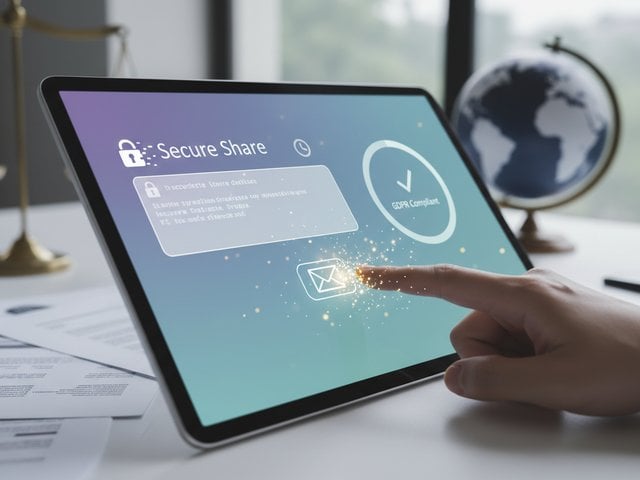
Share sensitive data with ephemeral messaging - gone after one read
Our one-time note tool is built for exactly the ephemeral messaging use case this article covers - send credentials, personal data, or regulated information through a self-destructing link that vanishes the moment the recipient reads it, leaving no persistent copy behind.
Create an ephemeral note →
No. Ephemeral messaging satisfies specific GDPR obligations - mainly data minimization, storage limitation, and right to erasure - for the data shared through it. You still need a lawful basis for processing that data, a signed DPA with your tool provider, a broader data retention policy, and compliance across all your other data processing activities.
They are different but complementary. End-to-end encryption protects data in transit so only sender and recipient can read it. Ephemeral messaging controls how long data exists after delivery. The strongest solutions combine both - the message is encrypted in transit and then permanently deleted after being read or after a set time.
If the data has already self-destructed before the erasure request arrives, there is nothing to delete - which technically satisfies the request. However, if the message still exists within its expiry window when the request comes in, you need to be able to trigger deletion immediately. Confirm your tool supports manual deletion before the timer runs out.
Healthcare (special category data under Article 9), financial services (high-value personal and financial data), HR and recruitment (candidate data with short retention windows), and legal services (privileged and confidential client information) all have the most to gain. These sectors handle data where over-retention carries the heaviest regulatory and reputational risk.
Yes, if you are using that provider to process personal data on your behalf - which is almost always the case. GDPR Article 28 requires a written DPA with every data processor. The DPA should specify what data the provider processes, how long it is retained (even ephemerally), security measures in place, and sub-processor arrangements.