



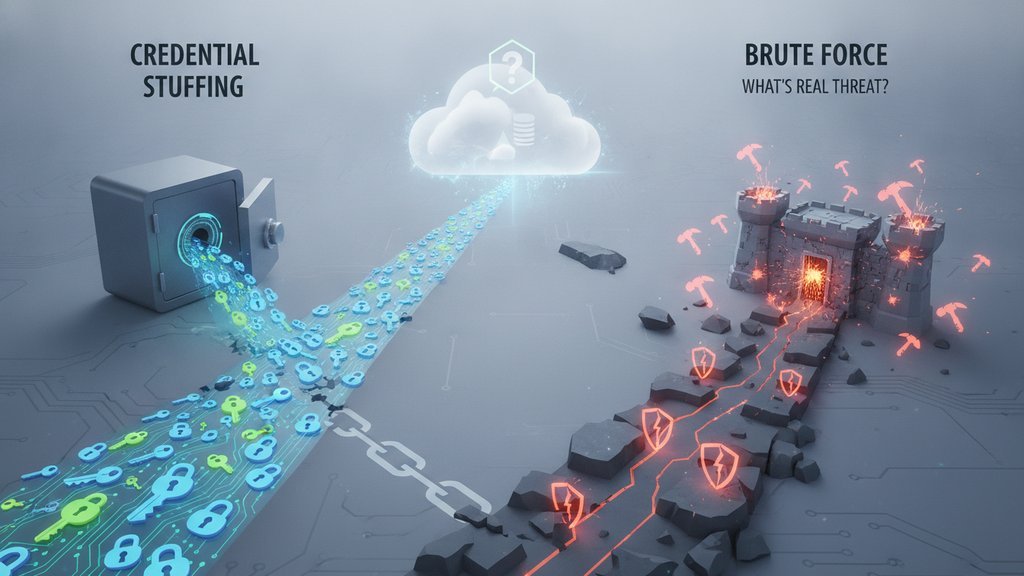
Credential stuffing and brute force are both automated login attacks, but they work in opposite ways. Brute force guesses passwords by trying many combinations against one account, while credential stuffing reuses real username and password pairs stolen from past breaches, betting that people recycle the same login everywhere. Credential stuffing is by far the more common and dangerous threat today because it exploits human password reuse instead of raw computing power.
Content Table
The core difference at a glance
Both attacks aim for the same prize: account compromise. The difference is what the attacker feeds into the login form.
| Factor | Credential Stuffing | Brute Force |
|---|---|---|
| What it uses | Real leaked username + password pairs | Guessed or generated passwords |
| Target | Many accounts, one guess each | One account, many guesses |
| Success rate | 0.1% to 2% per list, but huge volume | Very low against strong passwords |
| Needs prior breach data | Yes | No |
| Main weakness exploited | Password reuse | Weak or short passwords |
What is credential stuffing
Credential stuffing takes lists of already-leaked logins and "stuffs" them into other websites' login pages using bots. The attacker isn't guessing. They already have a working password from some other breach, and they're checking whether you reused it somewhere else.
Here's the typical flow:
- A company gets breached and billions of email/password pairs leak. The 2019 "Collection #1" dump alone held over 770 million records, indexed on Have I Been Pwned.
- Attackers load those pairs into automation tools that rotate through thousands of proxies to dodge IP blocks.
- They fire the pairs at unrelated sites (banking, streaming, retail).
- Every match becomes a hijacked account, ready to drain funds, resell, or use for fraud.
The math is what makes it work. Even a 0.5% hit rate on a 10-million-pair list yields 50,000 compromised accounts. Because each attempt uses a different account, it often slips past defenses that only watch for repeated failures on a single login.
How brute force and dictionary attacks work
Brute force is the older, blunter method. It targets a single account and tries password after password until one works or defenses kick in. There are a few flavors of these password attack methods:
- Pure brute force: systematically tries every possible character combination (aaaa, aaab, aaac...). Effective only against short or simple passwords, since length explodes the possibilities.
- Dictionary attacks: instead of random strings, the tool runs through a wordlist of common passwords, leaked favorites, and predictable patterns like "Summer2024!". Far faster than pure brute force because most people pick guessable passwords.
- Password spraying: tries a few very common passwords against many accounts to avoid lockouts, a reversal of the classic one-account approach. The key point in credential stuffing vs password spraying is that spraying still guesses passwords, while stuffing reuses real leaked ones.
Brute force struggles online because most services throttle or lock accounts after a handful of failed attempts. It's far more dangerous offline, where an attacker who has stolen a database of password hashes can run billions of guesses per second on their own hardware. That's why how those hashes are stored matters so much, and why the way data is encrypted at rest versus in transit plays a direct role in how survivable a breach is.
Which is the real threat
For most people and businesses today, credential stuffing is the bigger threat, and it isn't close.
- Scale: Automated login attacks powered by breach data run constantly. Security teams routinely report that a large share of all login traffic on major sites is malicious stuffing attempts.
- Low effort: Attackers don't need to crack anything. The passwords are already valid somewhere.
- Hard to spot: Each request looks like one normal login from one user. Spread across millions of IPs, it blends in.
- Brute force is largely solved: Rate limiting, lockouts, and long passwords make online brute force impractical against well-built sites.
Brute force still matters in two situations: weak-password accounts with no lockout protection, and offline cracking of stolen hash databases. But if you're ranking real-world risk to your accounts right now, password reuse feeding credential stuffing tops the list.
How to defend against both
The good news: a short list of habits shuts down both attack types at once.
- Use a unique password for every account. This single step makes credential stuffing useless against you. A strong random password generator lets you create long, unique passwords without inventing them yourself.
- Turn on multi-factor authentication (MFA). Even a valid password fails without the second factor. This is the single strongest defense against account compromise.
- Prefer passphrases and length. Long passwords make pure brute force astronomically expensive.
- Never share credentials over plain email or chat. Leaked internal messages become tomorrow's stuffing lists. When you must hand off a login, use a secure password sharing method that doesn't leave a copy sitting in an inbox.
- Watch breach alerts. Check whether your email appears in known dumps and rotate any reused password immediately.
For businesses, add bot detection, device fingerprinting, and rate limiting per account and per IP range. On the storage side, hashing passwords with a slow algorithm like bcrypt or Argon2 makes offline brute force painfully slow even after a breach. If you handle credentials in scripts or hand them between teammates, avoid pasting secrets into tickets or shared docs and lean on safer ways to share credentials without a vault instead.

Kill password reuse before attackers exploit it
The best defense in the credential stuffing vs brute force fight is a unique, long password for every account. Our free generator creates strong random passwords in one click.
Generate a strong password →
Not exactly. Both are automated login attacks, but brute force guesses passwords from scratch, while credential stuffing reuses real leaked username and password pairs. Stuffing relies on stolen breach data and human password reuse, not raw guessing power, which makes it faster and more effective at scale.
They buy or download credential dumps from past data breaches, often collections of hundreds of millions of records circulating on hacker forums. Because many people reuse the same password across sites, these old leaked pairs still unlock accounts on services that were never breached themselves.
Yes, largely. MFA requires a second factor beyond the password, so even a correct or stolen password fails without it. It's the strongest single defense against account compromise from both credential stuffing and brute force, though phishing-resistant methods like hardware keys are the most robust.
A dictionary attack is a smarter form of brute force. Instead of trying every character combination, it runs through a curated wordlist of common passwords and predictable patterns. It succeeds faster because most people choose guessable passwords, making it far more efficient than pure brute force.
You're at risk if you reuse passwords across sites. Check whether your email appears in known breaches using a service like Have I Been Pwned, and treat any reused password as compromised. Switch every account to a unique password and enable MFA to close the gap.